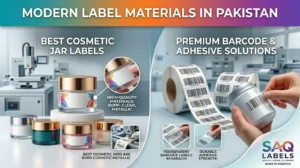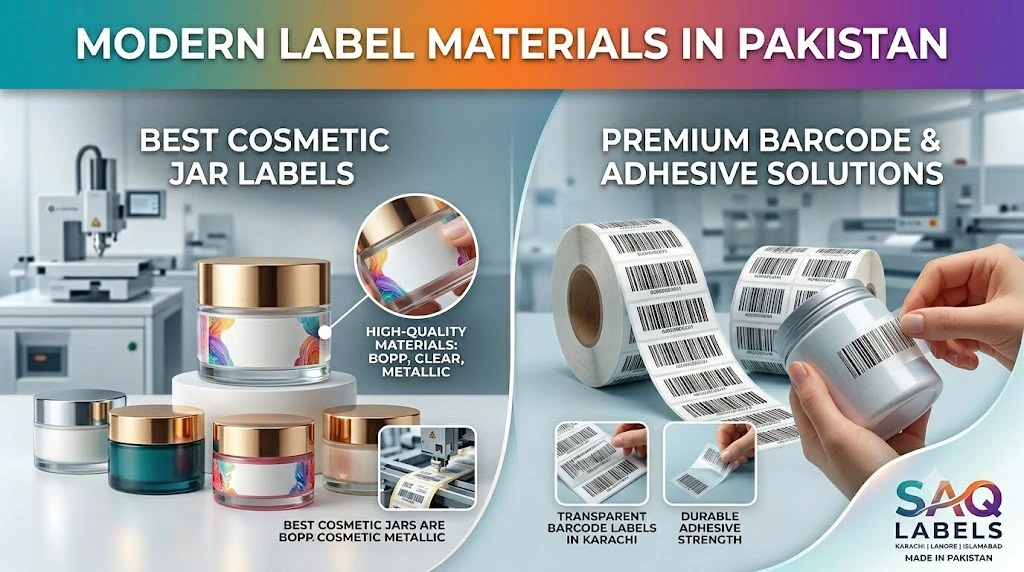
Choosing the right label materials for cosmetic jars in Pakistan is one of the most consequential packaging decisions a brand can make. The wrong material means peeling edges, bubbling in the bathroom, and a product that looks worn within days. The right choice keeps your label pristine from the retail shelf to the very last scoop.
This guide from SAQ Labels covers every material option – clear BOPP, white BOPP, matte BOPP, polyester (PET), and metallic foil – along with adhesive selection, finish options, a DRAP compliance checklist, and a quick-reference comparison table for Pakistan’s cosmetics market. Whether you’re producing a luxury anti-aging serum in glass or a mass-market body butter in plastic, the correct specification is here.
Quick-Reference: Label Material Comparison for Cosmetic Jars
Use this table to identify the right material at a glance. Detailed specifications follow below.
| Material | Best For | Moisture Resistance | Finish Options | Price Tier |
| Clear BOPP | Premium glass jars, no-label look | ★★★★★ | Gloss, Matte | Mid–Premium |
| White BOPP | Vivid colours on plastic jars | ★★★★★ | Gloss, Matte | Entry–Mid |
| Matte BOPP | Premium / natural skincare | ★★★★★ | Matte, Soft Touch, Spot UV | Mid-Premium |
| Polyester (PET) | Clinical / active-ingredient products | ★★★★★ | White, Clear, Silver | Premium |
| Metallic / Foil | Luxury cosmetics, gift sets | ★★★★☆ | Full Foil, Selective Foil | Premium–Luxury |
What Makes Cosmetic Jar Labeling Different from Other Packaging?
Cosmetic jars present a specific combination of labeling challenges that standard label specifications often fail to address. Before selecting a material, understand what your label will face throughout the product’s full life:
• Moisture exposure: bathroom steam, wet hands, Pakistan’s humid climate, and condensation from hot showers attack adhesion and material integrity
• Curved and tapered surfaces: most cosmetic jars are not flat – labels must conform to curves without bubbling, lifting at edges, or creasing
• Frequent handling: jars are opened, turned over, and gripped repeatedly – labels must resist scratching, abrasion, and finger grease
• Product residue: creams, oils, and butters can migrate to the jar rim and affect label edge adhesion over time
• Active cosmetic ingredients: high-concentration retinoids, exfoliating acids, and vitamin C derivatives can degrade standard label films
• Consumer aesthetic expectations: Pakistan’s premium segment now expects labels to remain pristine across the full use life of the product
The 5 Best Label Materials for Cosmetic Jars in Pakistan
1. Clear BOPP – Best for Premium Glass Jars
Clear BOPP (Biaxially Oriented Polypropylene) is the premier specification for premium cosmetic glass jars. The transparent film background disappears completely against the glass, leaving only your printed design visible. This ‘no-label look’ is one of the most commercially effective aesthetics in the premium skincare segment.
• Creates the no-label look – only the print floats against the glass surface
• Water-proof and resistant to bathroom moisture, steam, and Pakistan’s humidity
• Conforms well to curved jar bodies without bubbling or edge lifting
• Supports high-resolution digital printing with accurate colour reproduction
• Available in gloss or matte surface finishes
Best for: Luxury face creams, premium glass serums, high-end body butters, and any glass jar where the container itself is part of the brand aesthetic.
2. White BOPP – Best for Vivid Brand Colours on Plastic
White BOPP provides an opaque white background that gives printed colors their full intended vibrancy and accuracy. Color reproduction on white BOPP is significantly better than on clear BOPP – critical for brands with specific Pantone references, complex label graphics, or bold brand identities.
• An opaque white background delivers vivid, accurate colour printing
• Waterproof and durable across the full product life
• Available in gloss or matte
• Works on both glass and plastic (PP and PET) cosmetic jars
Best for: colorful skincare brands, plastic cream jars, and mass-market to mid-tier cosmetics, where visual impact is the priority.
3. Matte BOPP – The Premium Skincare Standard
Matte BOPP has become the signature label material of premium skincare brands globally – and Pakistan’s growing premium cosmetics segment is adopting the same standard. The non-glare matte surface creates a quiet, sophisticated appearance that resists fingerprints on retail shelves and photographs beautifully for e-commerce and social media. Consumer research from Cosmetics Europe consistently associates matte packaging with premium and natural brand positioning.
• Non-glare surface signals premium quality without being ostentatious
• Fingerprint-resistant – maintains a clean, shelf-fresh appearance in retail display
• Pairs exceptionally well with soft touch lamination for a velvety tactile finish
• Works with matte or spot UV print effects for visual depth and contrast
• Photographs well for e-commerce – reduces glare in product images
Best for: Premium serums, anti-aging creams, professional skincare lines, and natural and organic brand positions.
Matte BOPP with UV spot varnish is one of the most cost-effective luxury label combinations available in Pakistan. The contrast between the smooth matte surface and glossy spot elements creates a premium high-end visual effect while keeping production costs accessible.
4. Polyester (PET) – For Clinical and Professional Products
Polyester labels are more rigid and dimensionally stable than BOPP. While less common in mass-market consumer cosmetics, PET is the correct specification for professional-grade, clinical, or dermatologist-recommended skincare products that require extra durability and resistance to active cosmetic ingredients.
Active ingredients such as exfoliating acids (AHAs and BHAs), high-concentration retinoids, and vitamin C derivatives can degrade standard BOPP labels over time. PET labels resist these ingredients reliably.
• Superior chemical resistance to active skincare ingredients
• More dimensionally stable – resists stretching and distortion
• Available in white, clear, and silver metallic finishes
• Preferred for professional clinic and dermatology product lines
Best for: Clinical skincare, dermatologist-recommended products, professional salon lines, and formulations containing exfoliating acids or high-concentration actives.
5. Metallic and Foil Labels – For Luxury Cosmetics
Gold or silver metallic labels – produced by hot stamping or digital foiling – convey luxury that no other material replicates. A full-foil label with an embossed logo immediately positions a product in the premium tier. Selective foil accents on a matte base label are one of the most cost-effective luxury labeling techniques available.
• Full-foil labels in gold or silver for unambiguous luxury positioning
• Selective foil accents on a matte base for maximum visual contrast at a lower cost
• Can be combined with embossing or debossing for a three-dimensional logo effect
• Photographs dramatically well – ideal for gift set and premium range presentation
Best for: Luxury face creams, anti-aging serums, prestige gift sets, and premium brand ranges commanding a price premium in Pakistan’s cosmetics market.
Which Adhesive Should You Use for Different Cosmetic Jar Materials?
The label adhesive must match the jar material precisely. A label that looks perfect in print but lifts off the jar within a week is a costly failure that damages brand reputation. The table below covers the most common jar surfaces found in Pakistan’s cosmetics market.
| Jar Material | Recommended Adhesive | Key Consideration |
| Glass | Standard permanent | A clean surface is essential before application |
| PP (Polypropylene) | High-tack permanent | Low-energy surface – standard adhesive will fail |
| HDPE | High-tack / specialty | Remove mould-release compounds before labeling |
| Acrylic / Luxury Resin | Specialised (test first) | Formulation varies – always conduct an adhesion test |
| Cold-stored / Refrigerated | Freezer-grade adhesive | Standard adhesive lifts below 4°C |
Important note for PP and HDPE jars: both are low-energy surfaces. Standard permanent adhesive does not bond to them reliably. Always specify high-tack permanent adhesive, and ensure containers are clean and free from mould-release compounds before label application.
What Finish Options Are Available for Cosmetic Jar Labels?
SAQ Labels’ Karachi facility offers the following finish options for cosmetic jar labels:
• Gloss Lamination: bright, reflective, scratch-resistant – the classic retail pharmacy and mass-market look
• Matte Lamination: sophisticated, fingerprint-resistant – photographs well for e-commerce and social media
• Soft Touch Lamination: velvety tactile surface; extremely popular in Pakistan’s growing premium cosmetics segment
• UV Spot Varnish: selective gloss accents on a matte base for visual depth and contrast effects
• Hot Stamp Foiling: metallic gold or silver foil applied to logos, brand names, and decorative borders
• Embossing / Debossing: three-dimensional surface relief for brand marks and logos – pairs well with matte lamination
Label Size Reference for Common Cosmetic Jar Formats in Pakistan
Label dimensions depend entirely on your specific jar size and shape. These are general starting references – always measure your container and provide exact dimensions to your label supplier for accurate die-cutting. The measurements below are for body or side panel labels.
| Jar Format | Approximate Label Size | Notes |
| 30ml glass jar (eye cream, spot treatment) | 40mm × 30mm | Small – plan DRAP text carefully |
| 50ml cream jar (standard face cream) | 60mm × 45mm | Most common cosmetic jar size in Pakistan |
| 100 ml cream jar (large moisturiser) | 75mm × 60mm | Sufficient space for full DRAP information |
| 200ml body butter jar | 100mm × 75mm | Wrap-around labels are is often preferred |
| Wrap-around label (any size) | Height = jar height; Width = circumference | Ensure 3–5mm overlap for a clean seam |
Always commission a printed proof at your final label size before approving the full run. Test legibility of Urdu and English text at arm’s length, and check that all DRAP-required information is clearly readable.
What Does DRAP Require on Cosmetic Jar Labels in Pakistan?
All cosmetics sold in Pakistan must comply with DRAP’s (Drug Regulatory Authority of Pakistan) labeling framework under the Drugs Act and relevant cosmetic product regulations. For cosmetic jars, the label must carry all of the following mandatory information:
• Product name and product type
• Net weight or net volume
• Full INCI (International Nomenclature of Cosmetic Ingredients) ingredient list
• Name and address of manufacturer or importer
• Batch number
• Date of manufacture and expiry date, or PAO (Period After Opening) symbol
• Directions for use
• Applicable warnings and precautions
If your jar is too small to carry all mandatory information on the primary label, a supplementary inner-box insert, neck tag, or peel-back label section may be required. Discuss small-container labeling requirements with your label supplier and a regulatory consultant before finalizing your design artwork.
For bilingual labels (English and Urdu), SAQ Labels prints bilingual cosmetic jar labels in both scripts. Urdu Nastaliq and Naskh scripts require more vertical space than Latin text – test legibility at your required print size during proofing.
Keep a copy of the current DRAP cosmetics labeling circular on file. Regulatory requirements are updated periodically, so always cross-reference your label artwork against the latest guidelines before launching any new product.
Label Application and Minimum Order Quantities
Two additional questions arise consistently for Pakistani cosmetics brands that are not always addressed in labeling guides:
Hand Application vs. Machine Application
For small-batch and artisanal cosmetics brands in Pakistan, labels are commonly applied by hand. Hand application requires labels with slightly repositionable adhesive or, at a minimum, a generous application window. For brands scaling to machine application, label rolls must be wound and core-specified to the exact requirements of the labeling machine.
Digital Printing vs. Flexographic Printing
Short-run cosmetic jar labels (under approximately 1,000 units per SKU) are best produced via digital printing, which requires no plate costs and allows variable data (batch numbers, expiry dates) to be printed in-line. Flexographic printing offers lower per-unit cost at higher volumes and is ideal for established brands running consistent large quantities.
Discuss your volume requirements with SAQ Labels to determine which print process and minimum order quantity fits your production schedule.